Mosaicos: Las brochas
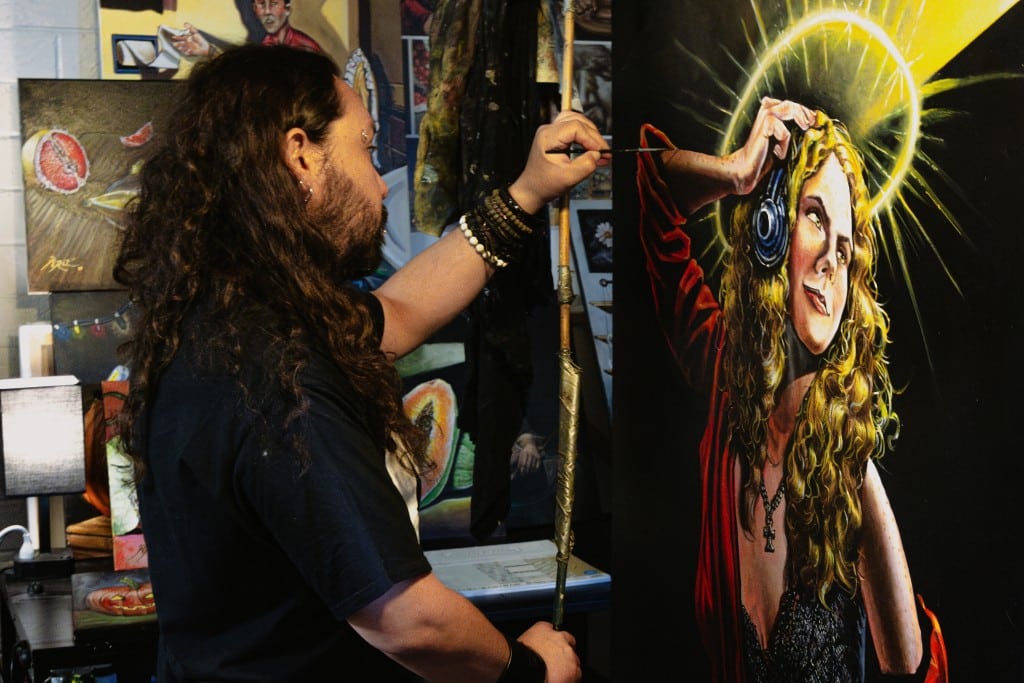
Los gestos de la mano casi idénticos,
los dedos, la muñeca, la intención;
lo que pinta y lo pintado
se funden en la punta mínima de un pincel,
en cada una de las cerdas,
y se pierde aquello que separa el lienzo
de la realidad inmaterial,
que separa a quien pinta, de su mundo interior.
Todo queda fundido en un gesto.
¿Quién es María Magdalena de los dos?
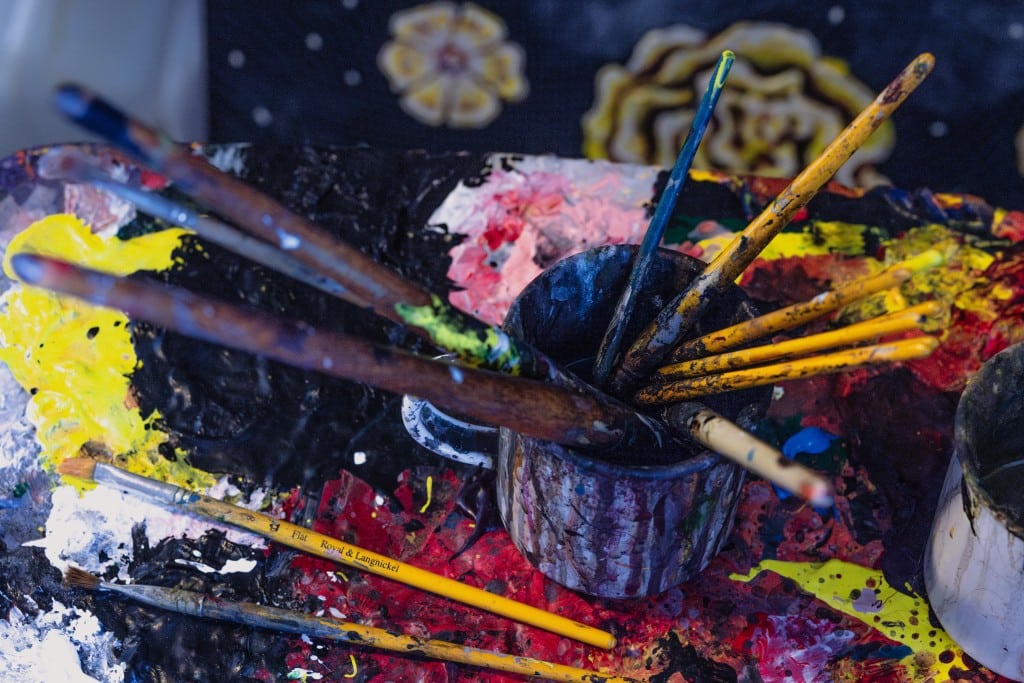
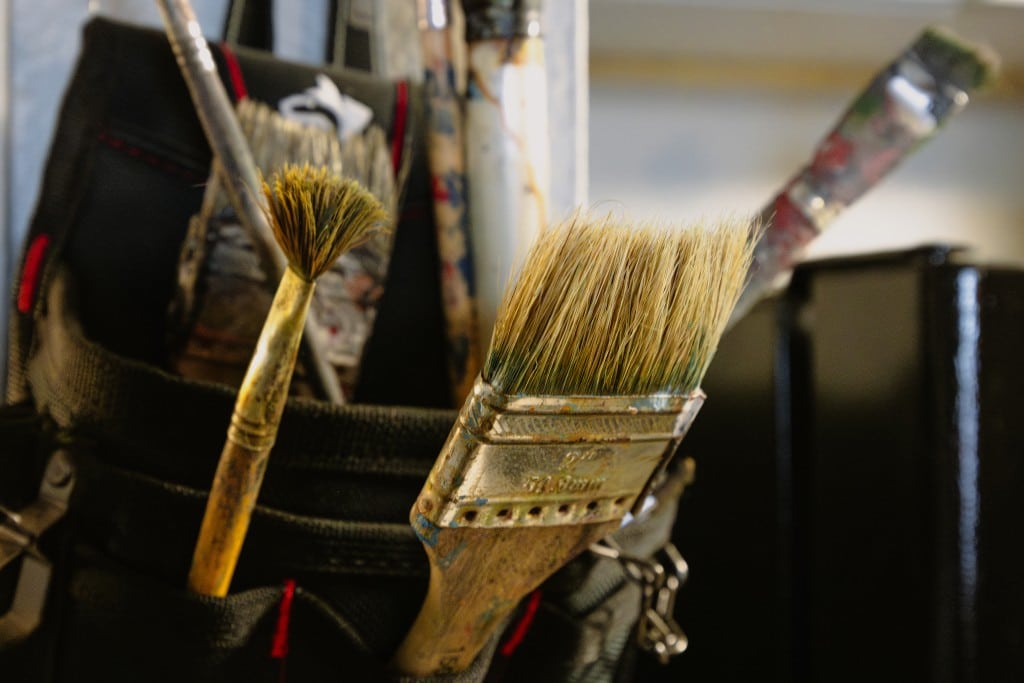
Los pinceles, cuando reposan, contienen
las historias que callaron, que callan,
las que Diego todavía no liberó,
mezcladas, mixturadas con
las que pintó y, al pintar,
dejó en el aire de las calles
de Coyoacán, de Phoenix,
donde se crió, donde está.
Los ojos de una Old woman,
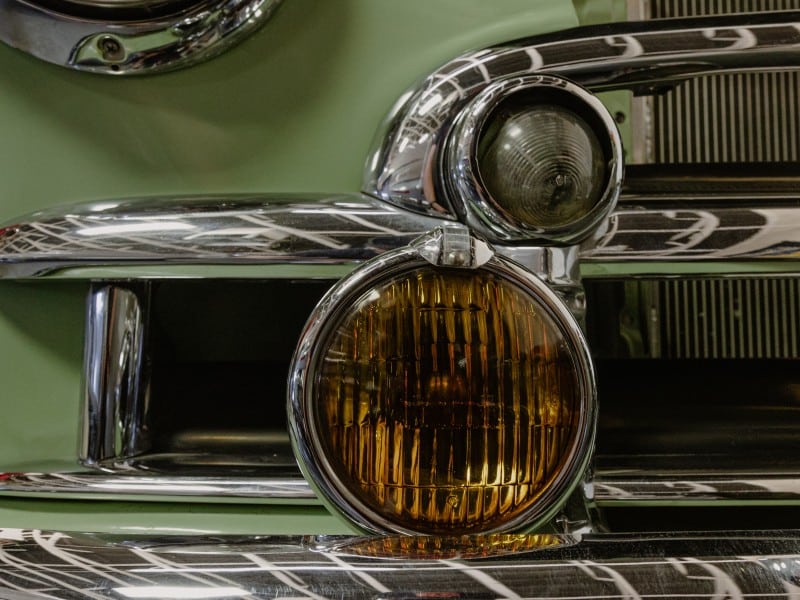
la herrumbre del auto de My grandpa’s car,
se mezclan en los pinceles
con todas las historias que aún no empezó a pintar.
Y eso convierte a un simple tarro de pinceles
en un universo de conversaciones, secretos,
recuerdos, silencios
que solo hay que saber escuchar.
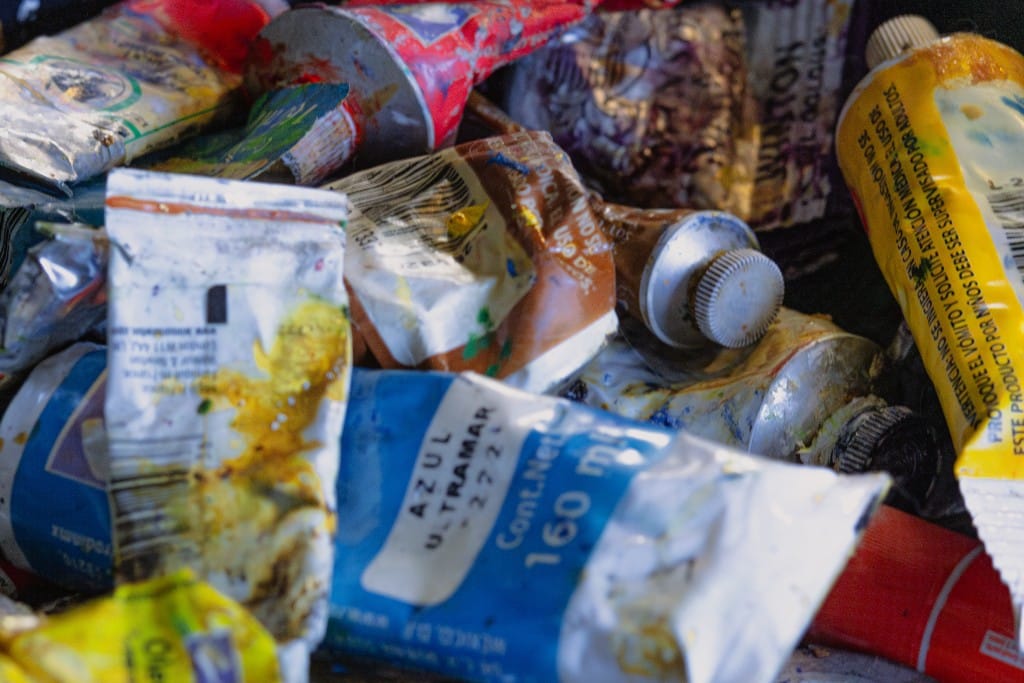
¿Y si en cada pomo está contenido el trozo de la vida que a Diego lo trajo hasta acá? ¿Qué tal si el amarillo fuera todo lo creado en la secundaria de artes a la que asistió y el azul el premio que le otorgó el presidente de México a sus 16? ¿Y si el rojo es todo el impulso que lo dejó en Phoenix desde México? Ese rojo que fue dejando a su paso en la mirada de cada latino, asiático, afroamericano, blanco que lo vio ―que vio sus murales― en el Valle del Sol. Ese rojo a lo largo de las vías sur del tren ligero de la estación Broadway Central. Ese rojo ―o azul o amarillo― que vieron y, sin darse cuenta, se llevaron consigo, a sus casas, a sus barrios, a sus comunidades, a su sensibilidad. Esos pomos contienen, de algún modo, las miradas de todas las personas que verán su obra en las calles de la ciudad.
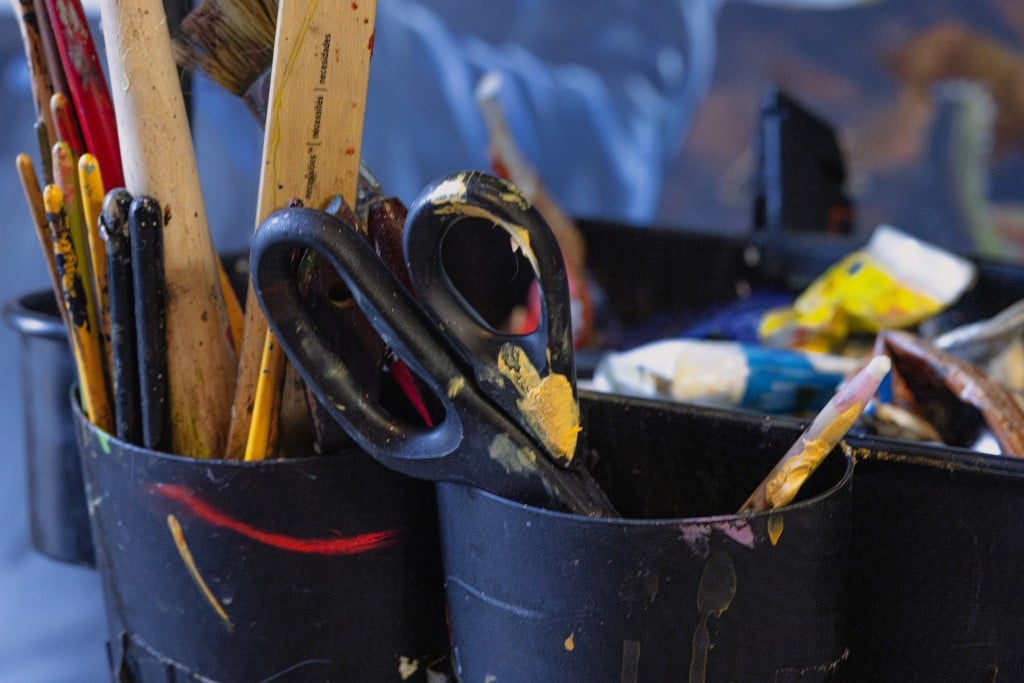
Porque, ¿cuándo empieza una obra? ¿Empieza cuando empieza a aparecer sobre el lienzo o cuando por primera vez se toma un pincel, una guitarra, un lápiz, una cámara… un pincel? Como cuando Diego, con ocho años, pintó por primera vez junto a su tío pintor. ¿Con cuántos pinceles, pomos, tijeras, reglas construyó Diego su hoy? Ser artista es tener nuestra historia cargada en artículos cotidianos. Y ser artista latino es llevar el continente en cada tarro, lápiz, cámara, pincel.
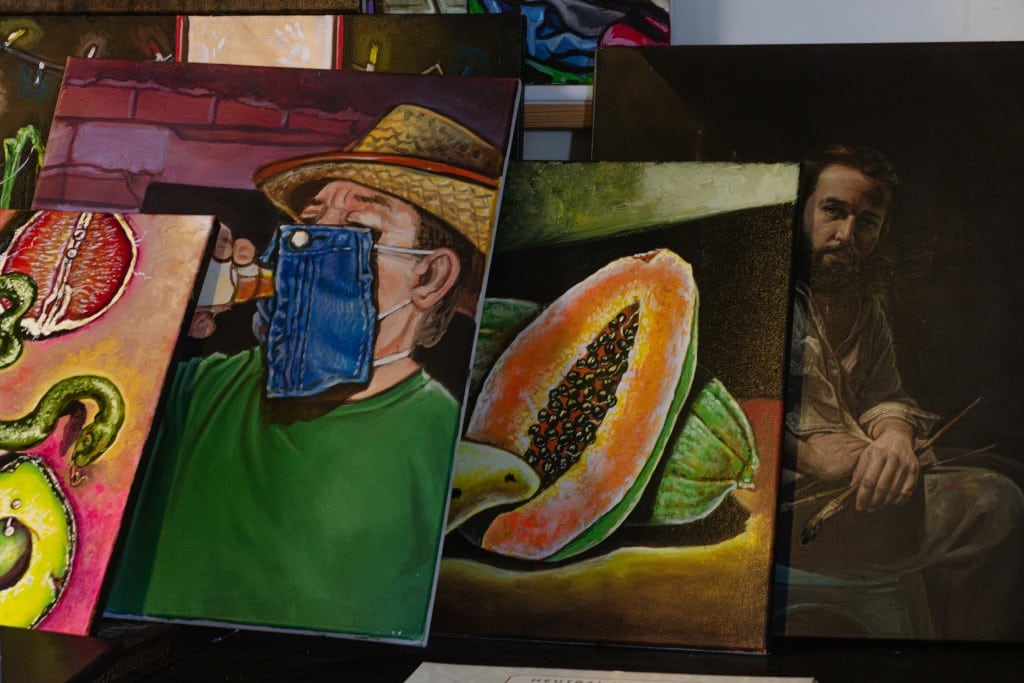
Instala su mirada con sensibilidad e ironía que hacen temer y reírnos de nuestro temor en un solo lienzo, en un solo trazo de color (mientras Diego nos mira sonriendo desde el último cuadro). Al mirar esas obras creemos en la fuerza de su color, de todos sus colores. De los que teje con los hilos de esta ciudad que lo adoptó, como todos los latinos que ―con pintura, música, letras, ideas, cine, reflexiones― tejen la trama invisible y sostenedora de la tierra que los recibió.
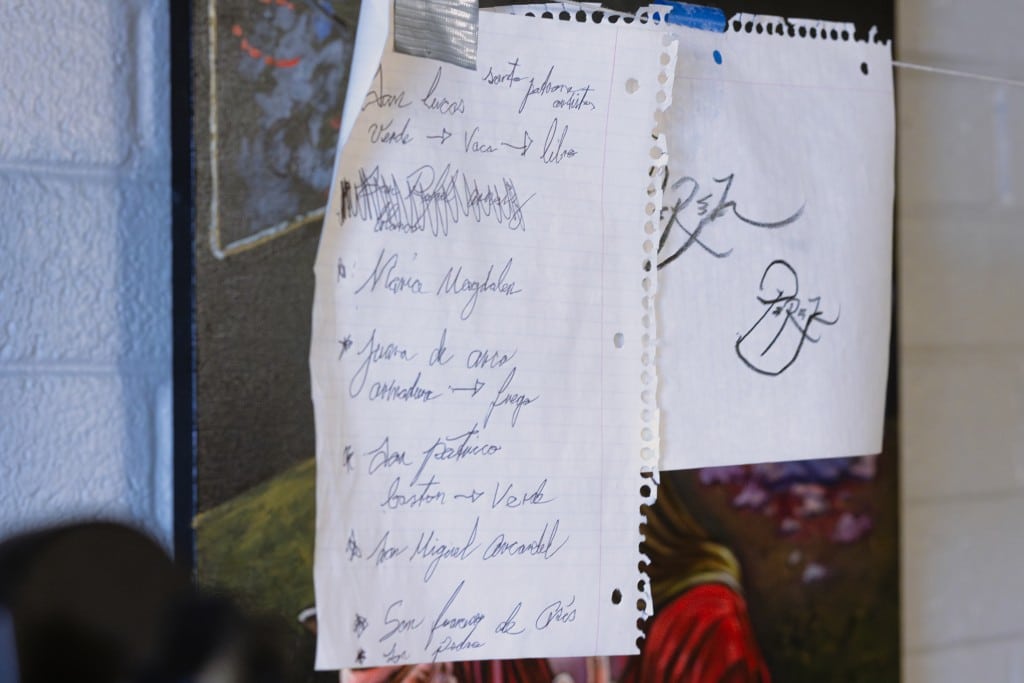
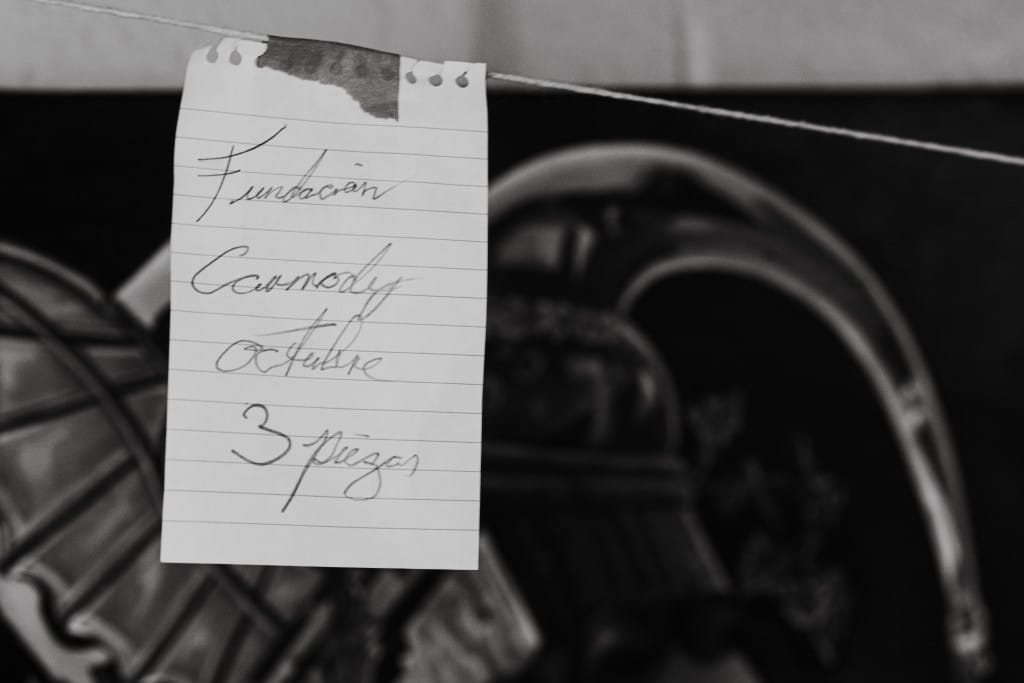
Esa trama que nos conecta con los santos que no son otra cosa que nosotros. Por eso, un trozo de papel pegado con cinta en el estudio de un artista latino puede ser un manifiesto. Manifiesto de quiénes somos, de dónde llegamos, de para qué. ¿María Magdalena con auriculares? ¿Juana de Arco con armadura y fuego? San Patricio, San Pedro, San Miguel manifiestan un universo de vivencias, creencias, sentimientos que los latinos llevan consigo ―semillas― para hacer brotar la tierra del lugar al que van. Un trozo de papel pegado con cinta es un manifiesto de fertilidad.
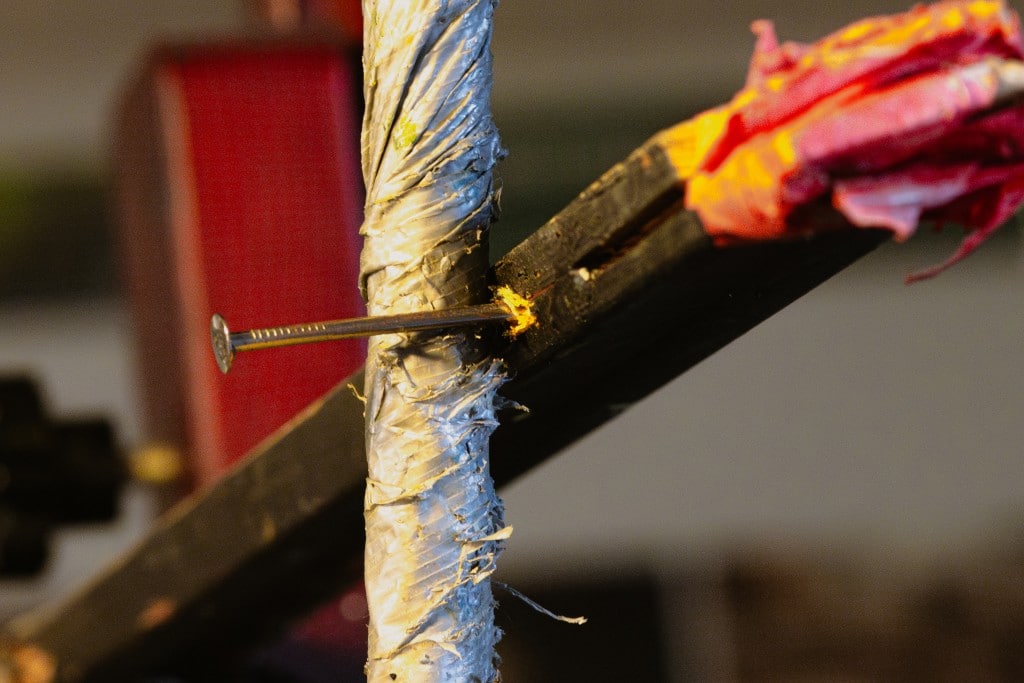
Hay algo en la estructura que sostiene un lienzo, un mural. Algo que nadie ve pero está ahí (casi como el clavo de la cruz). Algo como los silencios entre las notas. Algo como todo lo que sostuvo a Diego para que pudiera llegar hasta acá.
En la paleta de un pintor hay algo
que encapsula costumbres ―como la de un encendedor―,
costumbres presentes y antiguas,
culturales, históricas, atávicas
desparramadas en figuras que gritan
en la paleta de un pintor.
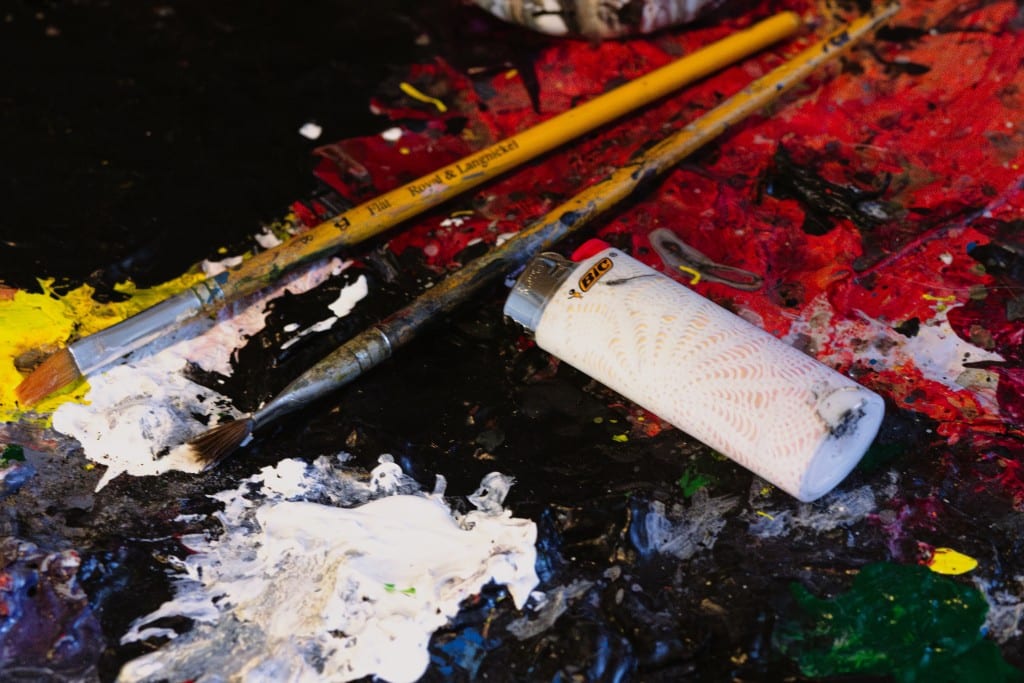
Hay algo entre las cerdas de un pincel,
algo como el silencio entre las notas,
el aire / el instante / el espacio /
que nos permite atisbar un resquicio
de ese algo más que toda la vida buscamos.
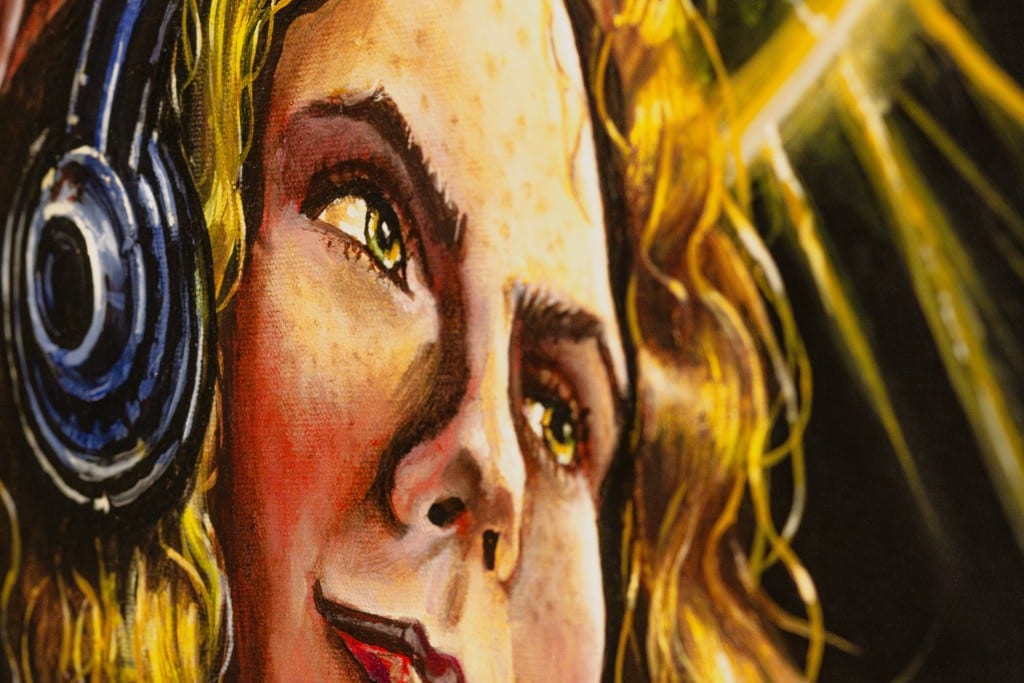
Algo como los ojos de María Magdalena
(¿o son los de Diego?)
que logran enfocar con la mirada
lo que siempre aspiramos alcanzar.
Lo miran, con esos ojos de María Magdalena
(¿o son los de todos los latinos en el norte?),
lo alcanzan con la mirada. Y entonces,
al mirar a esta María Magdalena
(de todos los latinos),
sentimos que lo alcanzamos también.
En el amarillo de sus ojos
(de un pomo lleno de historias que lo gestó).
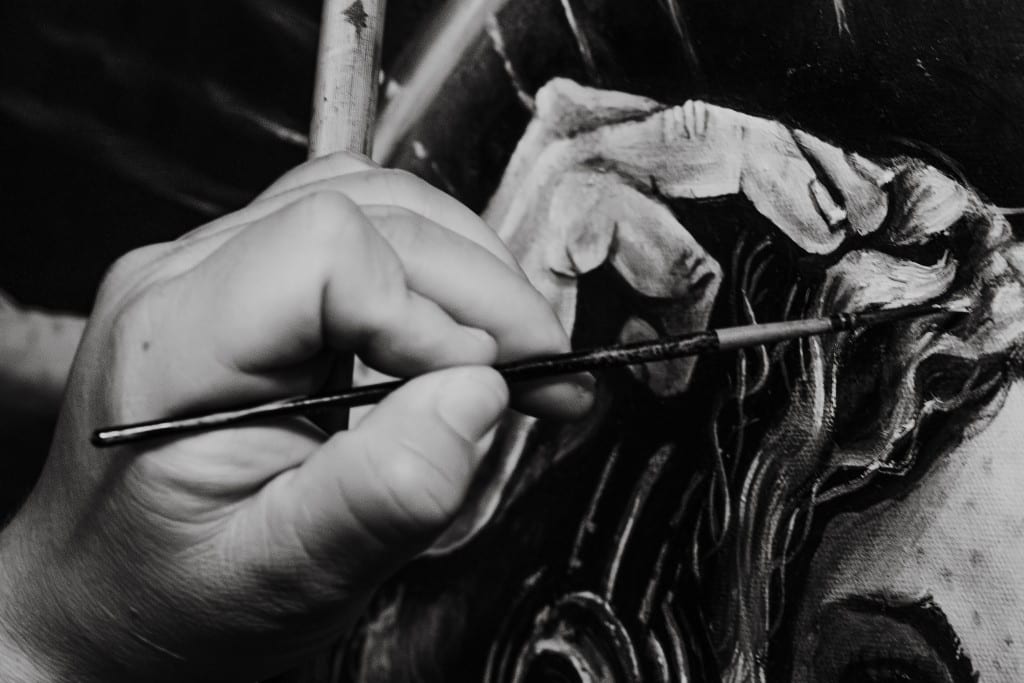
Por eso Diego pinta, en detalle,
cada movimiento del cabello,
cada sombra,
cada indicio de la luz.
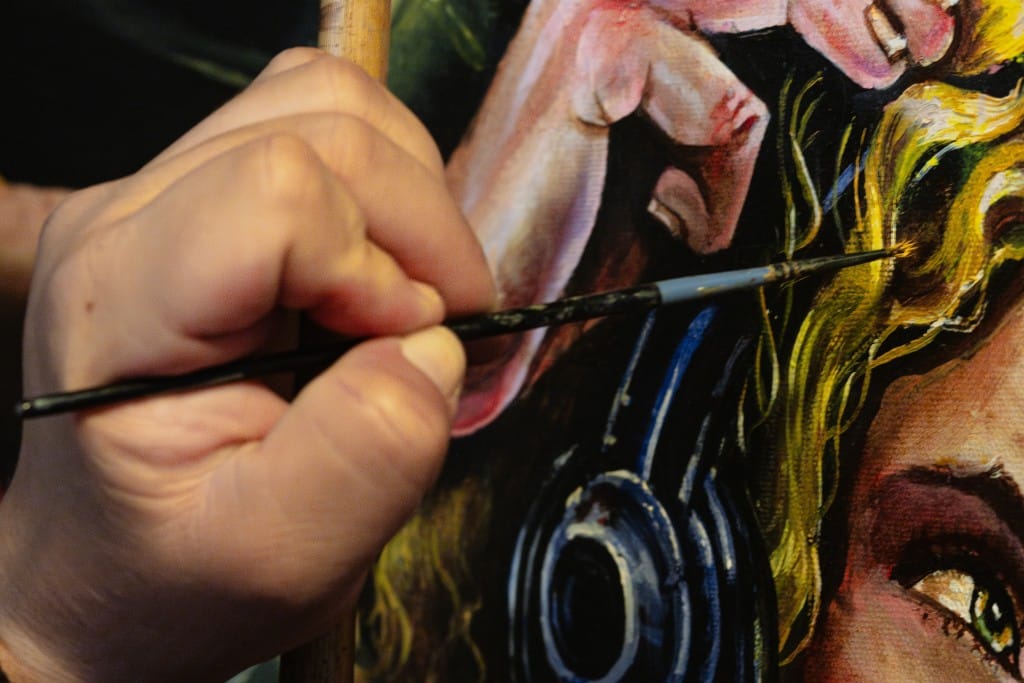
¿Cuándo empieza una obra?
Quizás empieza apenas cuando termina,
cuando es expuesta y la miramos,
cuando la llevamos en nuestros ojos
a nuestras casas, comunidades, historias, barrios.
Y la hacemos parte de nuestra vida.
Quizás es ahí, recién, cuando empieza.
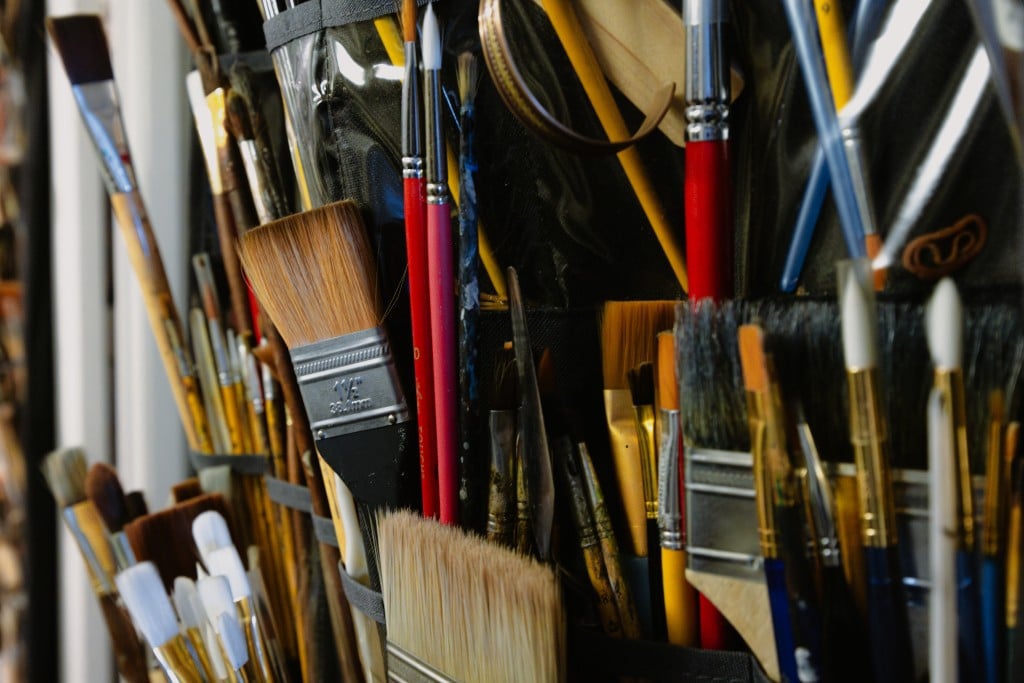
Los pinceles contienen, en sus cerdas,
los secretos de las historias
y, en el espacio entre ellas,
los silencios de lo que nunca se va a contar.
Unos pinceles en un estudio
esperan que les llegue
su momento de nacer.
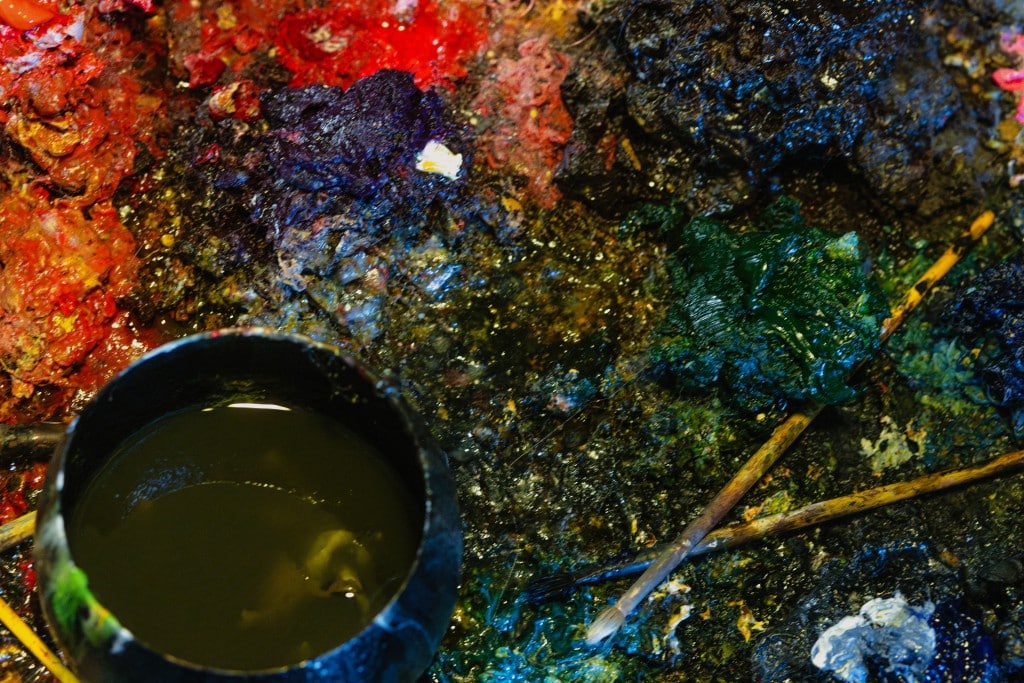
Las historias se deslizan por la madera
de los mangos de pinceles,
por las manchas delatoras de las paletas,
y se unen en el agua coloreada que las limpia,
que no las limpia, las mezcla,
mezcla personas y miradas,
barrios, comunidades, culturas.
Esa agua coloreada ahoga un trapo que quiso limpiar sus historias pero no.
Porque esa agua contiene todo lo que somos
/ latinos /
Esa agua es un mar.
/ nuestro mar /
Read in English
Mosaics: Las brochas
BY ANA LISSARDY & DANIEL ROBLES
The almost identical hand gestures,
the fingers, the wrist, the intention;
what paints and what is painted
merge at the tiny tip of a brush,
in each of the bristles,
and that which separates the canvas,
of immaterial reality is lost,
which separates the painter from his inner world.
Everything is fused into a single gesture.
Which of the two is Mary Magdalene?
When the brushes rest, they contain
the stories that were silenced, that remain silent,
those that Diego has not yet released,
mixed, blended with
those he painted and, in painting,
left in the air of the streets
of Coyoacán, of Phoenix,
where he grew up, where he is.
The eyes of an old woman,
the rust on My grandpa’s car,
blend together in the paintbrushes
with all the stories she has yet to paint.
And that turns a simple jar of paintbrushes
into a universe of conversations, secrets,
memories, silences
that you just have to know how to listen to.
What if each knob contains a piece of the life that brought Diego here? What if the yellow represented everything he created in the arts high school he attended and the blue represented the award he received from the president of Mexico at age 16? What if the red represented all the momentum that brought him to Phoenix from Mexico? That red that he left in the eyes of every Latino, Asian, African American, and white person who saw him—who saw his murals—in the Valley of the Sun. That red along the southbound tracks of the light rail at Broadway Central station. That red—or blue or yellow—that they saw and, without realizing it, took with them to their homes, their neighborhoods, their communities, their sensibilities. Those jars contain, in a way, the gazes of all the people who will see his work on the streets of the city.
Because, when does a work begin? Does it begin when it starts to appear on the canvas or when you first pick up a brush, a guitar, a pencil, a camera… a brush? Like when Diego, at the age of eight, painted for the first time with his uncle, a painter. How many brushes, knobs, scissors, and rulers did Diego use to build his present? Being an artist means having our history loaded into everyday items. And being a Latin American artist means carrying the continent in every jar, pencil, camera, and brush.
He fixes his gaze with sensitivity and irony that make us fear and laugh at our fear on a single canvas, in a single stroke of color (while Diego looks at us smiling from the last painting). When we look at these works, we believe in the power of his color, of all his colors. Colors woven with the threads of this city that adopted him, like all Latinos who—with paint, music, words, ideas, cinema, reflections—weave the invisible and sustaining fabric of the land that welcomed them.
That weave that connects us to the saints who are none other than ourselves. That is why a piece of paper taped to the wall of a Latino artist’s studio can be a manifesto. A manifesto of who we are, where we come from, and why. Mary Magdalene with headphones? Joan of Arc with armor and fire? Saint Patrick, Saint Peter, Saint Michael manifest a universe of experiences, beliefs, and feelings that Latinos carry with them—seeds—to make the land where they go sprout. A piece of paper taped to the wall is a manifesto of fertility.
There is something in the structure that holds up a canvas, a mural. Something that no one sees but is there (almost like the nail in the cross). Something like the silences between the notes. Something like everything that sustained Diego so that he could get here.
In a painter’s palette there is something
that encapsulates customs ―like that of a lighter―,
present and ancient customs,
cultural, historical, atavistic
scattered in figures that scream
on a painter’s palette.
There is something between the bristles of a brush,
something like the silence between notes,
the air / the moment / the space /
that allows us to glimpse a crack
of that something more we seek throughout our lives.
Something like the eyes of Mary Magdalene
(or are they Diego’s?)
that manage to focus with their gaze
what we always aspire to achieve.
They look at it, with those eyes of Mary Magdalene
(or are they those of all Latinos in the north?),
they reach it with their gaze. And then,
when looking at this Mary Magdalene
(of all Latinos),
we feel that we are also reaching him.
In the yellow of her eyes
(of a knob full of stories that gave birth to it).
That is why Diego paints, in detail,
every movement of the hair,
every shadow,
every hint of light.
When does a work begin?
Perhaps it begins only when it ends,
when it is displayed and we look at it,
when we carry it in our eyes
to our homes, communities, stories, neighborhoods.
And we make it part of our lives.
Perhaps that is when it truly begins.
The brushes contain, in their bristles,
the secrets of stories
and, in the space between them,
the silences of what will never be told.
Some paintbrushes in a studio
await
their moment to be born.
Stories slide down the wood
of the brush handles,
through the telltale stains on the palettes,
and come together in the colored water that cleans them,
which does not clean them, but mixes them,
mixes people and gazes,
neighborhoods, communities, cultures.
That colored water drowns a rag that wanted to clean their stories but didn’t.
Because that water contains everything we are
/ Latinos /
That water is a sea.
/ our sea /
The words are by Ana Lissardy and the photographs by Daniel Robles; edited by Maritza L. Félix.
Las letras son de Ana Lissardy y las fotografías de Daniel Robles; la edición es de Maritza L. Félix.
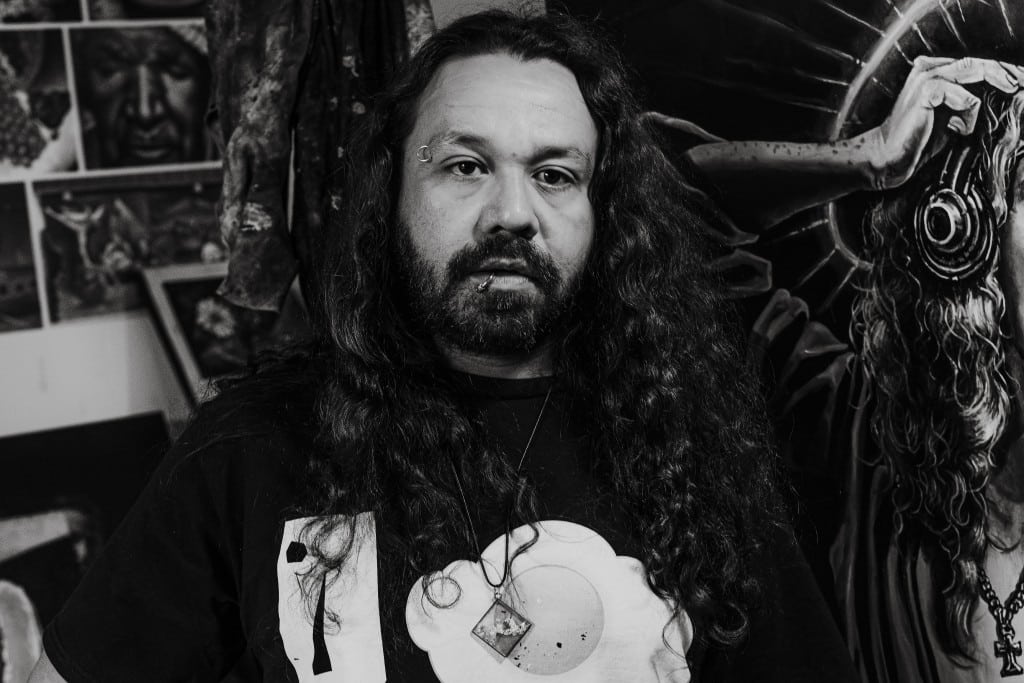
Diego Pérez ha sido galardonado en varias ocasiones. En 2007 obtuvo el Premio Nacional de Arte y Salud del INJUVE en México por su pintura. En 2014 ganó una comisión para el Museo Nacional de Ciencias Universum, donde cuenta con una exposición permanente de diez retratos de matemáticos.
Desde hace varios años vive y produce en Phoenix, donde ha sido reconocido por The Arizona Republic en su programa mensual Who’s Next, que destaca a líderes emergentes menores de 40 años en diversas áreas. En 2017 obtuvo el primer lugar en la exposición Conceptions Arts en Los Ángeles, así como el primer lugar en la muestra con jurado The Sunniest Place on Earth, organizada por el Yuma Art Center. Ha expuesto su obra en México, Argentina, España, Grecia y Estados Unidos.
Esta historia es un fragmento de Mosaicos, el proyecto de Conecta Arizona que recoge pedazos de vida, color y memoria, ensamblados como azulejos que celebran la belleza migrante y transfronteriza. Aquí cada relato y fotografía es una pincelada que honra la herencia vibrante, cruda y real que une ambos lados del muro.
Explora aquí otros matices, rostros e historias tejidas en colaboración con autores y artistas independientes.
Queremos que Conecta Arizona sea ese lugar en donde podamos darle un espacio, un eco y amplificar tus historias.
Plumas invitadas de Conecta Arizona
Autores